Description
Contractor: ALPIK 2010 Ltd
Scope of work: Grinding and protection of a concrete floor in a garage
As part of this project, the concrete floor of an underground garage with a total area of approximately 380 m² was treated in order to provide long-term protection against the penetration of oils, chemicals and de-icing salts – key factors in the deterioration of concrete in garage and parking environments. To achieve maximum durability and surface strength, a high-tech crystallizing hardener was selected: PAVILITIUM, a product based on nano-modified lithium silicates.
Challenge
Concrete floors in garages are exposed to intensive mechanical and chemical loads. The penetration of oils and contaminants, combined with the aggressive action of de-icing salts during the winter, leads to:
- development of microcracks;
- corrosion of reinforcement;
- accelerated degradation of the concrete structure;
- surface absorption and dusting.
To prevent these processes, a system with proven effectiveness in densifying, crystallizing and impregnating concrete in depth was chosen.
Product used: PAVILITIUM
Surface crystallizer and hardener based on lithium silicate
PAVILITIUM is a liquid, ready-to-use, non film-forming, water-based product which penetrates between 10 mm and over 30 mm into the top layer of the concrete and triggers a crystalline reaction between the nano-molecular lithium silicates and the free calcium hydroxide in the concrete structure.
This reaction:
- builds a stable crystalline lattice within the cement matrix;
- densifies and consolidates the surface layer of the concrete;
- increases compressive strength as well as abrasion and impact resistance;
- reduces surface absorption (impregnates the concrete);
- improves the chemical resistance of the floor;
- helps achieve a dust-free surface;
- prevents efflorescence and alkali–aggregate reactions.
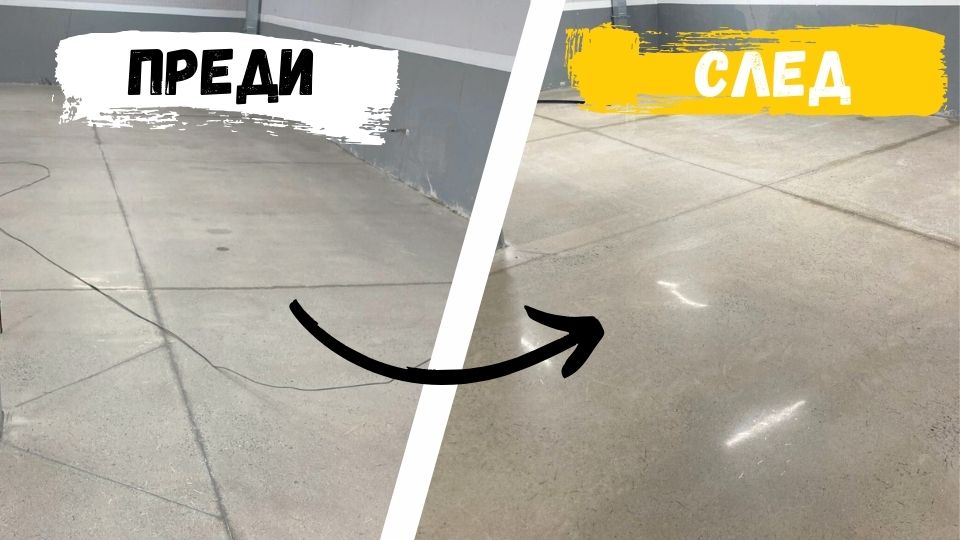
As a result, the concrete surface becomes long-term protected, dense and easy to maintain, with an attractive polished finish.
Process of treating the garage floor
1. Diamond grinding of the floor
The first stage involved grinding the concrete floor with diamond discs, which:
- removed weak and friable surface layers;
- further closed the concrete surface structure;
- provided an optimal base for the even penetration of PAVILITIUM;
- improved the uniformity and homogeneity of the surface.
This preparation is crucial to achieving maximum effect from the subsequent crystallizing treatment.
2. Rubbing in PAVILITIUM with a single-disc machine
After the preparation, the floor was treated with PAVILITIUM, which was applied and mechanically rubbed into the concrete using a single-disc machine fitted with white pads.
This mechanical rubbing:
- activates the crystallization reaction in the surface layer;
- ensures deep and even penetration of the product;
- keeps the concrete constantly “saturated” with the solution for optimal performance;
- helps distribute the product evenly, without the formation of dry spots.
3. Polishing after 24 hours
After the chemical reaction was completed and the crystalline structure stabilized, the floor was polished again. This:
- reinforced the achieved finish;
- enhanced the visual effect of the polished concrete;
- further reduced the porosity of the surface;
- created a durable, dust-free and easy-to-clean floor.
Result after treating the garage floor
After the completion of all stages, the garage floor achieved:
- significantly increased mechanical strength of the surface;
- high resistance to oils, fuels and chemicals from vehicle traffic;
- protection against salts and freeze–thaw cycles under winter conditions;
- reduced absorption and elimination of dusting;
- deeply densified and crystallized surface of the concrete floor;
- an aesthetic polished appearance, suitable for heavily trafficked garage and parking areas.
The chosen solution is long-lasting and significantly extends the service life of the concrete floor while at the same time reducing maintenance and repair costs in the long term.