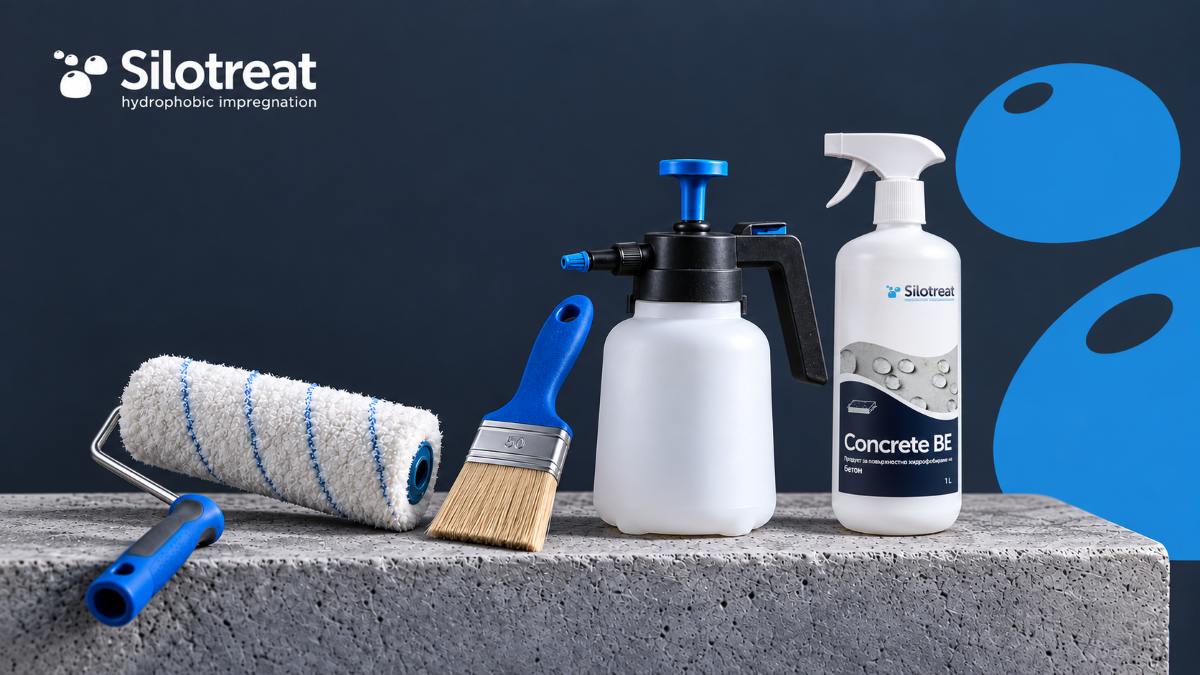
“Can I apply the impregnation with a brush or roller?”
This is one of the most common questions we receive about SiloTreat® impregnating products. And it is a perfectly reasonable question. When treating concrete, stone, brick, plaster or wood, the first association is often with painting – we take a roller or brush and spread the product over the surface.
Impregnation works differently.
SiloTreat® is not a paint or coating designed to form a continuous layer on the substrate. The aim is to apply a sufficient amount of product evenly to the surface so that the substrate becomes properly saturated and the impregnation can penetrate into the porous structure of the material.
For this reason, we recommend spraying as the primary application method for SiloTreat® impregnating products. In addition to providing better control over even saturation, spraying is also significantly faster – an advantage that becomes particularly important when treating large areas.
Impregnation is not painting
When painting, the main objective is to spread the material over the surface so that, once dry, it forms a covering layer. With impregnation, the objective is different.
Concrete, natural stone, bricks, mineral plasters and wood have a porous structure. The impregnating product needs to reach this structure, and the substrate must absorb the required amount of product.
Therefore, the aim is not simply to “spread” the product over the surface, but to deliver it evenly to the substrate and allow the material to absorb it.
The surface should be thoroughly saturated without leaving untreated areas and without applying excessive amounts that could run down vertical surfaces or form puddles on horizontal ones.
Why do we recommend spray application?
1. Even saturation and better control over the amount applied
When sprayed correctly, the product reaches the surface directly, allowing the operator to monitor how the substrate absorbs the impregnation during application.
This is important because different materials have different levels of porosity and absorption. Even within the same surface, some areas may absorb the product at different rates.
With spray application, these differences are easy to observe – highly absorbent areas take up the liquid quickly, while on less absorbent areas the product remains visible on the surface for longer. This allows the amount of product to be adjusted during application according to the behaviour of the substrate itself.
2. Easier application on textured surfaces, joints and irregularities
Real construction surfaces are rarely perfectly smooth. Stone may have a pronounced texture, concrete can be rough, brickwork contains joints, wood has its own natural structure, and mineral plasters can be highly textured.
A roller works through direct contact and therefore reaches the raised areas most effectively. With spraying, the product can reach recesses, joints, edges and other difficult-to-access areas much more easily.
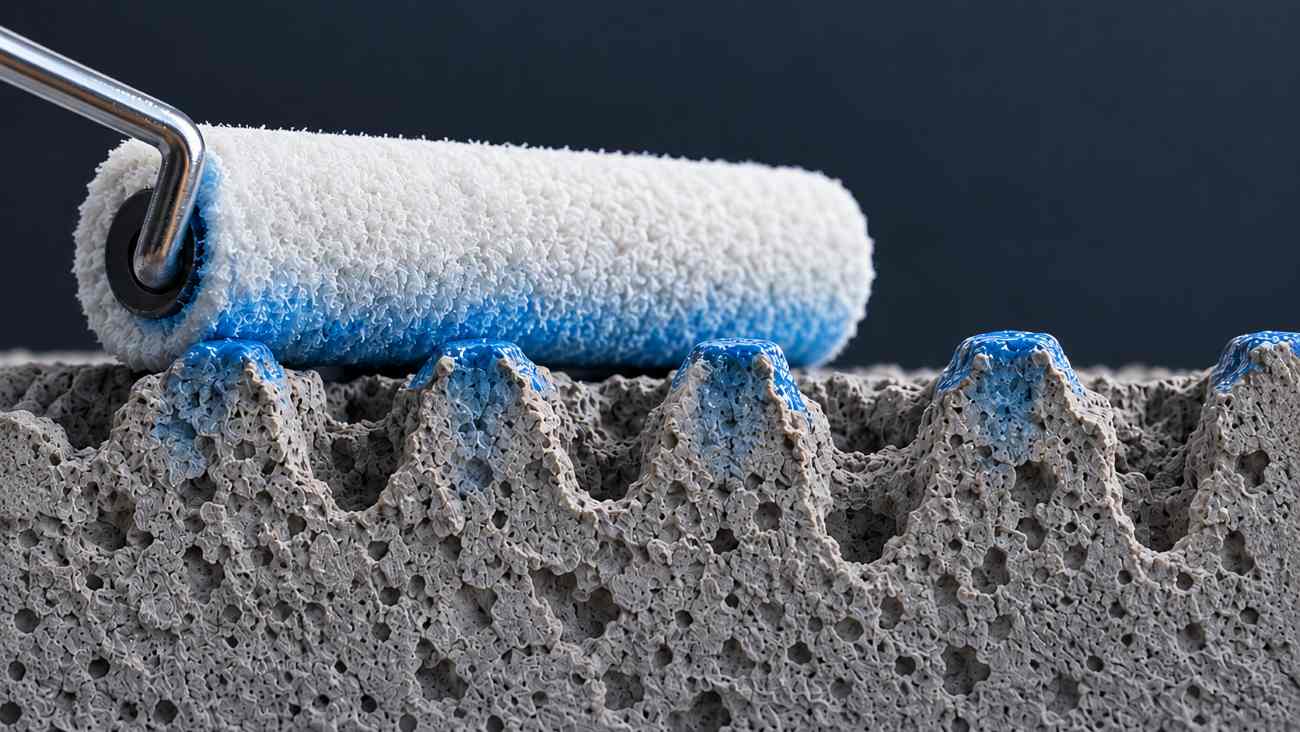
*The blue colour of the liquid is used for better visual presentation. SiloTreat® impregnating products are not paints and do not change the colour of the substrate being treated.
3. Significantly faster application
One of the major practical advantages of spraying is speed. The product is delivered directly to the surface being treated, allowing a significantly larger area to be impregnated in a shorter time compared with application using a roller or brush.
For a small area, the difference may seem insignificant. But when treating a façade, concrete floor, stone cladding or another surface covering tens or hundreds of square metres, it has a direct impact on the time and labour required to complete the job.
There is no need to repeatedly reload a roller, make multiple passes over the same area or subsequently treat areas that the roller could not reach.
Spraying is therefore not only a way to apply the product evenly. It also allows the same operation to be completed much faster and more efficiently – something that matters both to professional contractors and to people treating their own terrace, façade or flooring.
Is there a role for the brush in impregnation?
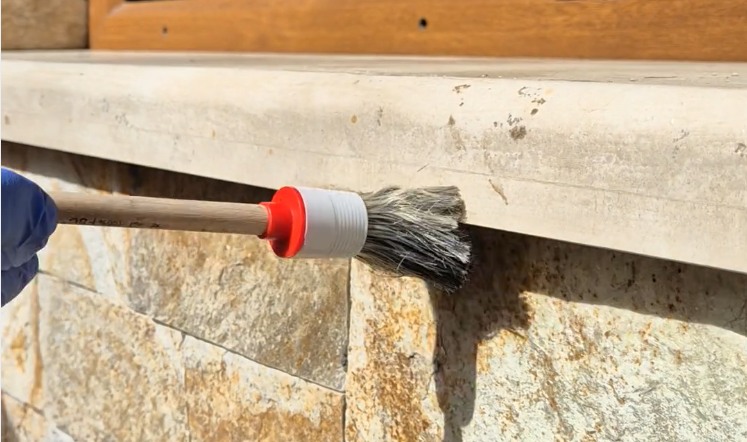
Yes. Although we do not recommend it as the main tool for applying SiloTreat®, a small brush is very useful for removing runs or drips when treating vertical surfaces, as well as for treating individual details and difficult-to-access areas.
A typical example is the drip edge on the underside of a window sill, where a small brush can be used to apply the product precisely over the entire detail. In the same way, narrow edges, corners, joints and other areas where local application is more convenient than spraying can also be treated.
In other words, the brush is not a “forbidden” tool. It simply has a different role – we use it for details, while the main surface is treated by spraying.
How should the impregnation be applied correctly by spraying?
Spray application does not mean atomising the product into the finest possible mist. The aim is not to lightly “dust” the surface, but to deliver a sufficient amount of impregnation for the material to absorb.
The surface should be thoroughly and evenly saturated with the product.
On vertical surfaces, application should proceed systematically. The amount should be sufficient to saturate the material, but not so excessive that long runs form down the surface.
On horizontal surfaces, the objective is again even saturation without allowing excess product to form puddles. If an excessive amount accumulates in a particular area, the excess should be spread out or removed promptly.
Is professional equipment necessary?
The choice of equipment depends mainly on the size and specific characteristics of the area being treated.
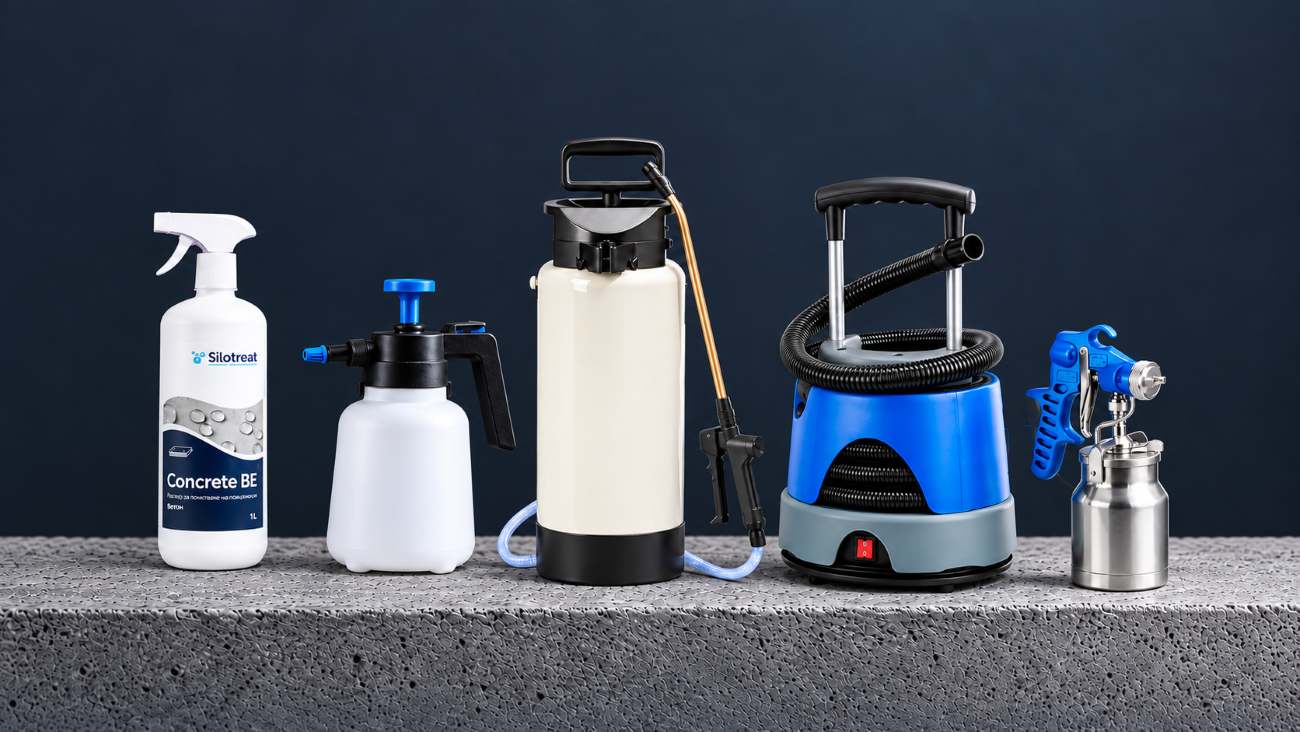
For small areas and individual objects, a simple hand sprayer may be sufficient. For larger areas, a manual pressure sprayer or backpack sprayer can be used, while suitable professional spraying equipment is appropriate for large-scale projects.
From a small hand sprayer to professional equipment, the principle remains the same – even spraying, sufficient saturation and fast application.
One principle for different materials
We recommend spray application when using SiloTreat® impregnating products on:
- concrete;
- natural stone;
- brick;
- mineral plasters;
- wood;
- porcelain stoneware;
- roof tiles;
- leather products;
- textiles.
For textiles, impregnation by dipping is also possible, although this is a more specialised application method and is not necessary in most cases.
The specific consumption is not the same for every material. It depends on the product, porosity, structure and absorption capacity of the substrate, so the application instructions for the specific SiloTreat® product should always be followed.
Spraying is part of the correct impregnation process
Choosing between a sprayer, roller and brush may seem like a minor practical detail. With impregnation, however, this choice determines not only how evenly the product is applied, but also how long it will take to treat the entire area.
For this reason, we recommend spraying as the main application method for SiloTreat® – for even saturation, easier access to textured areas and significantly faster application. And when a particular detail requires it, a small brush remains a useful auxiliary tool.
Frequently Asked Questions
Can SiloTreat® be applied with a roller?
Physically, the product can also be applied in this way, but for the main application we recommend spraying. This makes it easier to achieve even saturation and allows the surface to be treated significantly faster.
Can I use a brush?
Yes. A brush is suitable as an auxiliary tool for small details, edges, drip edges on window sills and other difficult-to-access areas. For the main surface, we recommend spraying.
Is special equipment required?
No. A hand sprayer can be used for small areas, while a manual pressure sprayer or backpack sprayer is suitable for larger surfaces. Professional spraying equipment is appropriate for large areas.
How much product should be sprayed onto the surface?
Until the surface is thoroughly and evenly saturated. On vertical surfaces, excessive application that causes significant running should be avoided, while on horizontal surfaces the product should not be allowed to form puddles. The specific consumption depends on the product and the absorption capacity of the substrate.
Do you have questions or are you planning an impregnation project?
Contact the Leaf Group team. We will review the exposure conditions, photos and surface requirements and help you choose the appropriate product and application method.