
Hydrophobic Impregnation of Granite and Natural Stone | Protection Against Moisture and Rust
In architecture and construction, natural stone - and granite in particular - is often perceived as a symbol of durability and longevity. It is no coincidence that it is widely used for façades, paving, staircases, cladding and representative architectural spaces.
However, behind the impression of an “eternal material” lies one important fact - even granite is not a completely closed system.
Under a microscope, every stone surface reveals a complex network of micropores and capillaries. These allow moisture to penetrate deep into the material and trigger processes that initially appear to be only cosmetic defects but may eventually lead to actual structural deterioration.
When the Investment Does Not Look the Way You Expected
Natural stone cladding and paving are rarely a random choice. They are usually a decision backed by a significant investment, attention to detail and the desire for a building to preserve its premium appearance for many years.
This is why disappointment often comes not when a structural problem appears, but much earlier - after the first periods of heavier rainfall.
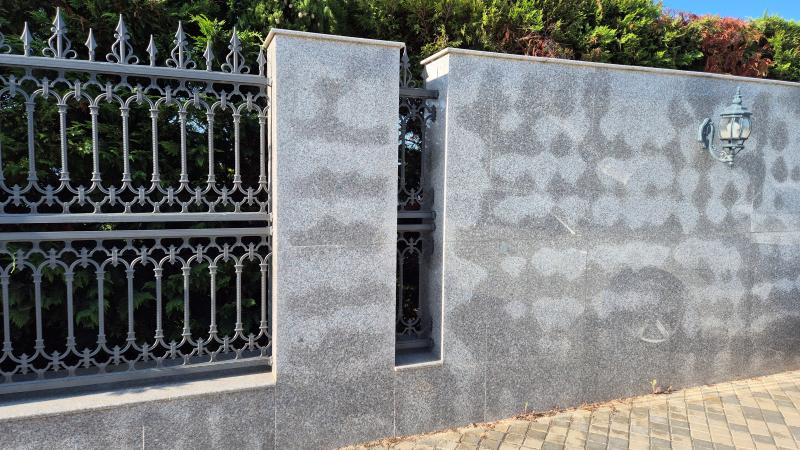
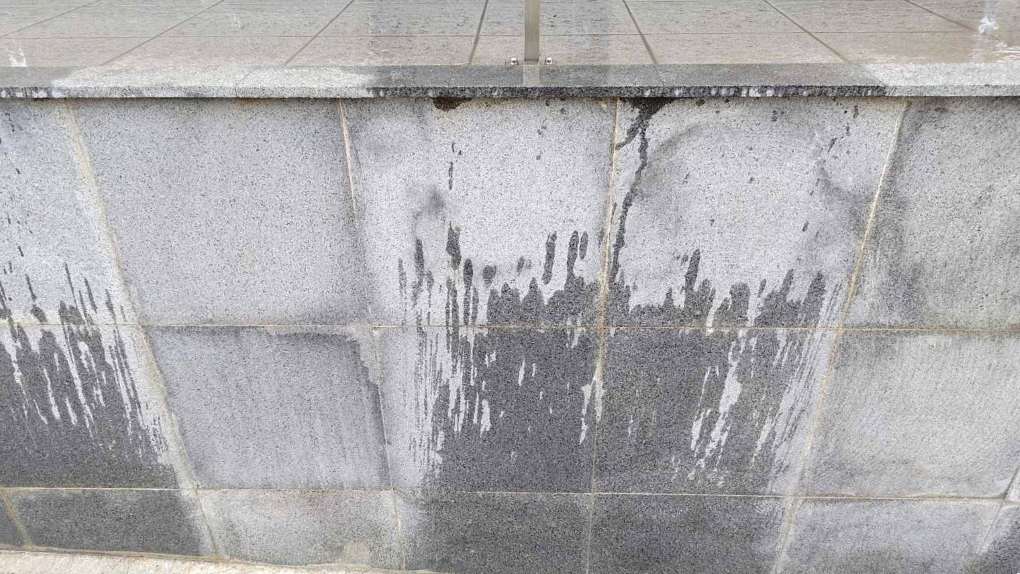
Stone begins to darken unevenly, and dark streaks, local wet areas and rust-like stains appear. A surface that looked clean, uniform and premium when dry suddenly starts looking old, dirty or poorly maintained.
In many cases, this does not mean the material itself is defective. More often, the reason is that natural stone remains unprotected against the way water interacts with its internal structure.
How Moisture Penetrates Stone - The Physics of Capillary Absorption
The main mechanism is capillary absorption.
When water reaches the surface - from rain, melting snow, condensation or regular wetting - it starts moving inward through the natural pores of the material. The longer the surface remains wet, the deeper the moisture penetrates.
But water rarely enters alone.
Together with moisture, dissolved mineral salts, dust particles, atmospheric pollutants, acidic compounds and organic contaminants enter the stone.
As a result, moisture becomes not just a carrier, but an active factor in the ageing of the material.
The Visible Problem: Dark Streaks and the Permanent “Wet” Effect
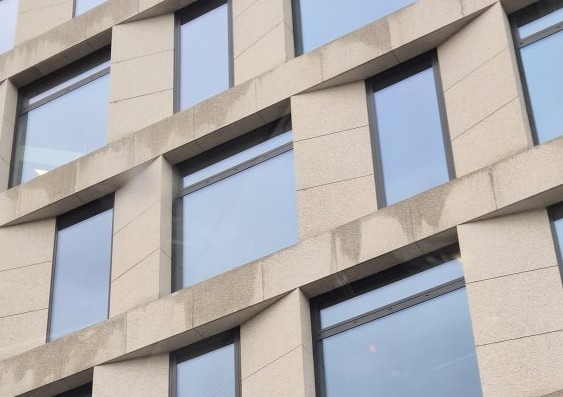
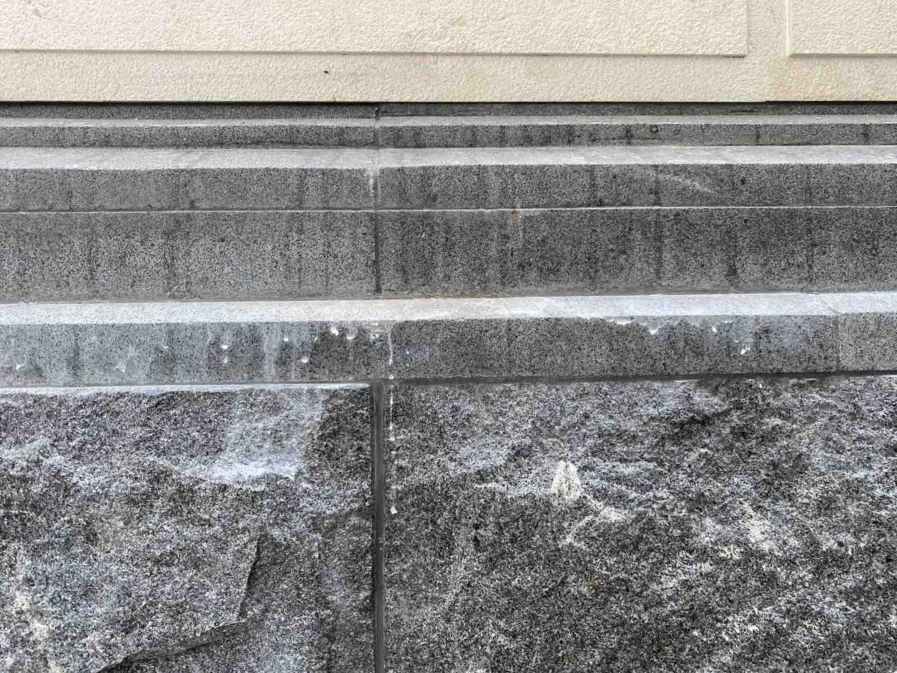
One of the earliest symptoms is uneven darkening after rainfall.
When stone has no protection, different areas absorb different amounts of water. This leads to characteristic dark streaks and marks, creating the visual impression of a permanently wet and dirty surface.
This is not only an aesthetic issue.
The longer the material remains wet, the more the time of wetness increases - a critical factor that accelerates dust accumulation and creates favorable conditions for microorganisms, moss and biological deposits.
Over time, these contaminants penetrate deeper into the structure and become increasingly difficult to remove.
Not Every Rust Stain Comes from Outside. Sometimes the Stone Itself Is the Source.
Why Rust Appears on Granite - Chemical Weathering from the Inside Out
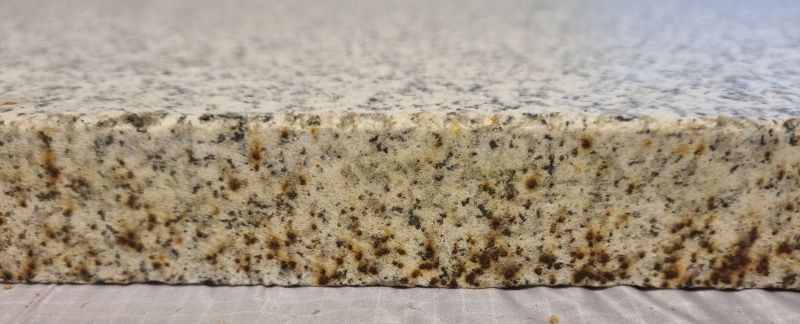
Rust-colored stains on granite are often mistaken for external contamination.
In reality, in many cases the source lies inside the stone itself.
Granite naturally contains iron-bearing minerals such as biotite, amphibole and pyrite. Under normal conditions these minerals remain stable and invisible.
The problem begins when water penetrates the structure.
The incoming moisture transports oxygen deep into the material and creates conditions for a chemical reaction - oxidation. During this process, iron within the minerals gradually transforms into new compounds - iron oxides and hydroxides - which produce the characteristic yellow, brown and reddish coloration.
This is why the stains resemble rust.
But the color is only the visible part of the problem.
During oxidation, the newly formed compounds occupy a greater volume than the original minerals, creating internal stress inside the stone.
Over time this may result in microcracks, weakening of mineral bonds, localized deterioration and the reappearance of stains even after cleaning.
Why Does Rust Return Even After Cleaning?
Mechanical or chemical cleaning may remove the visible stain from the surface, but it does not always eliminate the cause of its appearance.
If water continues to penetrate the structure of the stone, the oxidation process remains active. Moisture once again reaches the iron-bearing minerals, transports oxygen and creates conditions for the formation of new rust-colored compounds.
This is why stains often reappear in the same areas or around them, even after the surface has already been cleaned.
The real solution is not simply removing the stain, but interrupting the underlying mechanism - capillary water penetration into the stone.
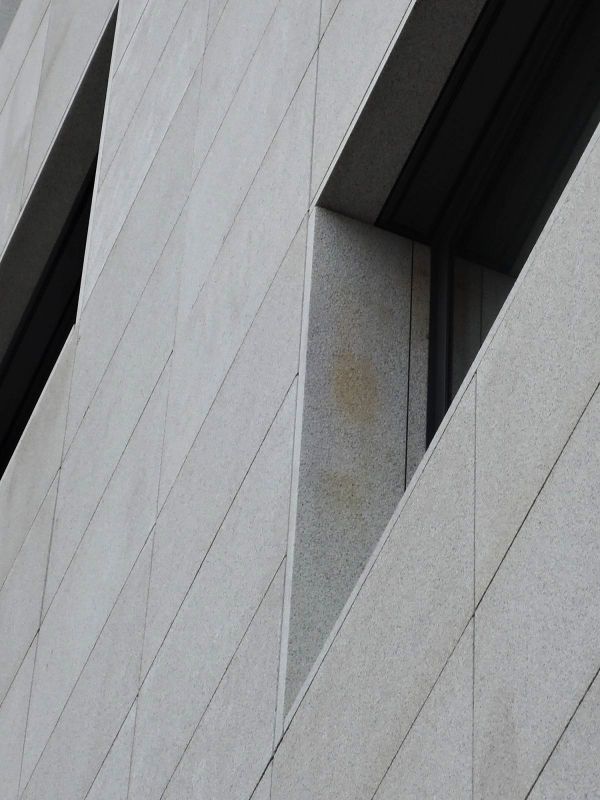
When Moisture Starts Destroying the Structure: Stone “Sugaring”
In addition to oxidation, moisture may also cause purely mechanical deterioration.
As the absorbed water begins to evaporate, dissolved salts remain inside the pores and start crystallizing. These crystals exert significant pressure on the pore walls.
Repeated wetting and drying gradually weakens the bonds between mineral particles.
In granite and other crystalline stones, this may lead to granular disintegration, commonly known as “sugaring” - a process in which the stone gradually loses density and begins breaking down into fine grains.
When temperatures drop below freezing, the volumetric expansion of frozen water further accelerates deterioration.
Why Dense Coatings Are Not Always the Right Solution
A common approach is to use coatings or sealers that create a continuous film.
This may temporarily stop external water, but at the same time blocks the natural movement of water vapor from inside the structure.
As a result, moisture becomes trapped inside the material.
The resulting internal stress often leads to peeling, surface deterioration, detachment and accelerated ageing.
For natural stone, protection should therefore be both water-repellent and vapor-permeable.
An Intelligent Approach: Deep Protection and Surface Protection
Step 1: Deep Protection with SiloTreat® Stone S+
SiloTreat® Stone S+ is a specialized deep silane-based impregnator.
Thanks to the extremely small size of its active molecules, the product penetrates the capillary structure and creates an invisible water-repellent barrier.
This significantly reduces water and dissolved salt penetration - the key factor behind internal oxidation, crystallization and deterioration.
Because the protection remains inside the structure, it does not form a surface film and does not alter the natural appearance of the stone.
Step 2: Surface Hydrophobic Protection with SiloTreat® Stone BE
Once deep protection is established, SiloTreat® Stone BE is applied.
The product acts at the level of surface tension and changes the way liquids interact with stone.
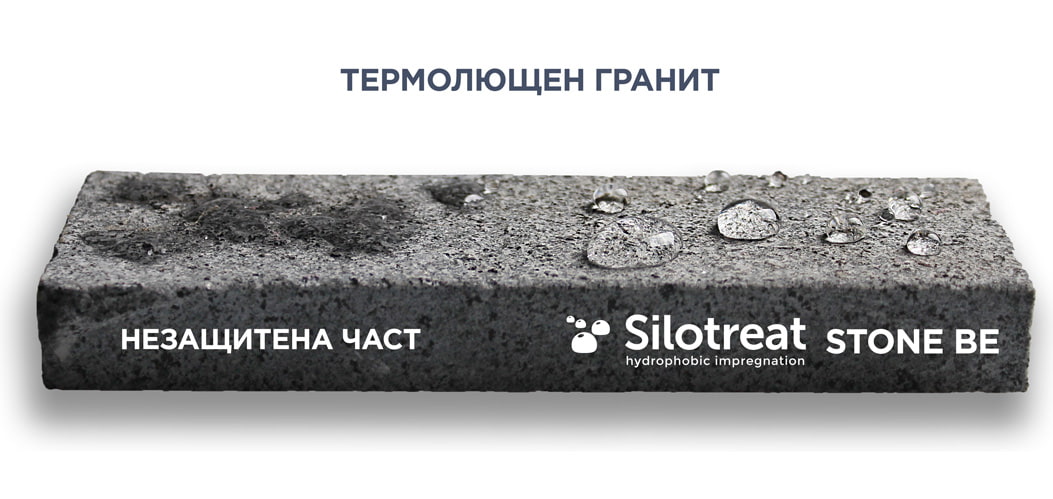
Instead of soaking in, water remains in the form of compact droplets and drains away much faster.
This reduces dark streaking, dust retention, contamination build-up and prolonged wetness.
As a result, a pronounced easy-to-clean effect is achieved.
What Do We Gain from Proper Impregnation?
- Reduced water penetration into the stone
- Lower risk of rust-colored stains
- Less contamination and easier maintenance
- Preservation of the natural color and texture
- Maintained vapor permeability
- Extended service life of cladding and paving
Conclusion
Stone is an exceptionally durable material - but it is not invulnerable.
Moisture does not simply wet the surface - it carries oxygen, salts and contaminants deep into the structure, where chemical and mechanical ageing processes begin.
That is why protection should not focus only on appearance, but on limiting the mechanism of deterioration itself.
A combined approach with deep protection and surface hydrophobic treatment helps preserve both the natural beauty of stone and its long-term durability.
With natural stone, the consequences often become visible only after the problem itself becomes visible. That is why proper protection starts not with choosing a product, but with understanding the cause.
Do You Have a Similar Problem? Let’s First Understand the Cause
If you recognize any of the symptoms described above - dark streaks after rainfall, stone darkening, rust-colored stains, permanently wet areas or contamination of the cladding - do not rush to choose a solution based only on appearance.
With natural stone, causes are often different and the right approach always starts with analysis.
We perform testing and condition assessment, analyze the results and the specific characteristics of each project in order to propose the most appropriate technological approach and solution depending on the stone type, exposure conditions and the actual problem.
Contact us so we can analyze the cause and propose a solution tailored to the specific stone, service conditions and the condition of your project.